
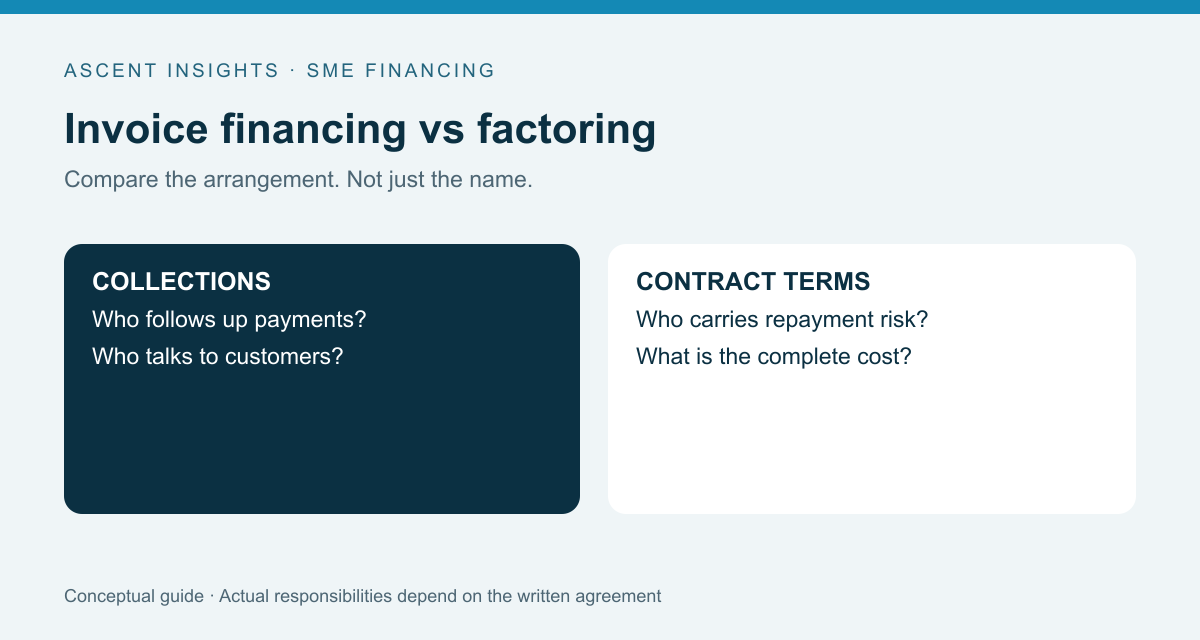
Invoice financing vs factoring is not always an either-or choice. Invoice finance is a broad description of funding linked to invoices; factoring is one structure within that family. For a Singapore SME, the useful comparison is between the actual facilities offered: who collects payment, what customers are told, what happens if an invoice remains unpaid, and what the agreement costs.
A product name alone cannot answer those questions. This guide provides a practical comparison framework before you discuss a facility with a financier. For help assessing available structures, see Ascent’s invoice financing and secured-financing advisory.
General business information, not individual financial, legal or accounting advice. Product terms and eligibility vary. Primary sources checked on 18 October 2026; confirm the current written offer before making a decision.
Start with the terminology, not the label
The British Business Bank’s invoice-finance guide distinguishes factoring, where the provider handles the sales ledger and collections, from invoice discounting, which does not include that management service. This is a useful explanation of the concepts, not a statement of Singapore eligibility or legal treatment.
Local terminology also needs checking. OCBC describes one product as Business Receivables Financing (Factoring), with the bank collecting customer payments. Its separate Short-term Financing page describes invoice funding for sales or purchases and says suppliers or debtors are not made aware of that financing. These are product-specific descriptions, not rules for every provider.
When requesting a comparison, explain the business problem in plain language: “We have issued invoices and need cash before customers pay,” or “We need to pay a supplier before delivering an order.” Those are different needs. This article focuses on customer receivables; a purchase-invoice facility should not be assumed to work in the same way.
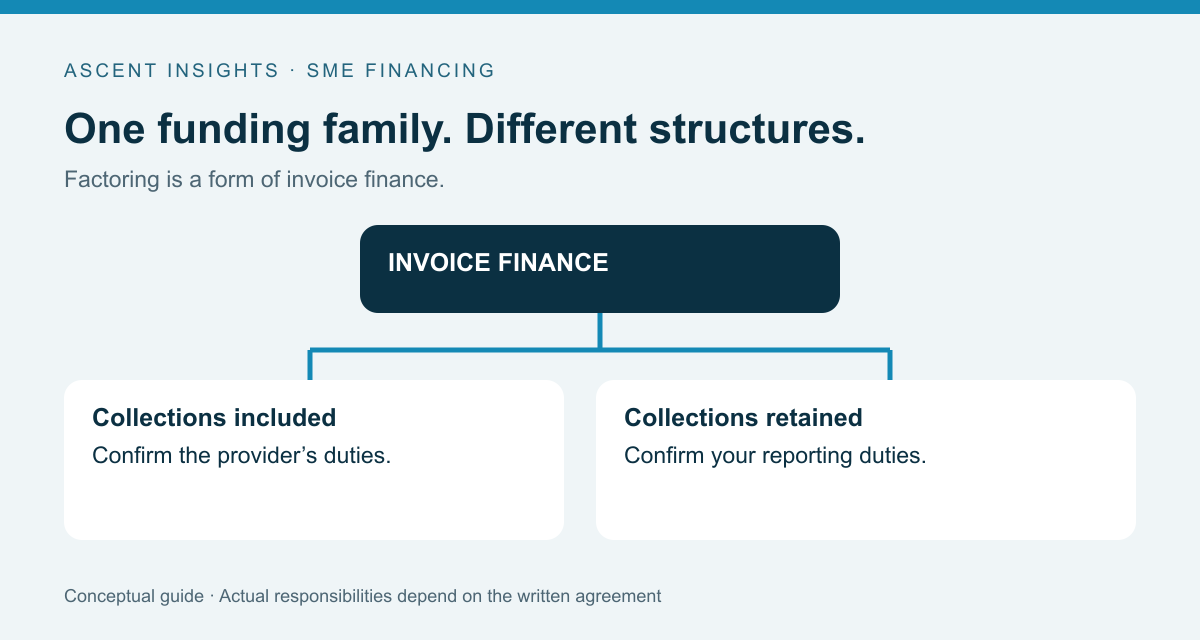
A practical invoice financing vs factoring comparison
| Decision | A collection-inclusive factoring arrangement | An arrangement where you retain collections |
|---|---|---|
| Customer payments | The provider takes on agreed collection duties. | Your business continues the agreed collection process. |
| Customer communication | Confirm notices, payment instructions and who contacts the customer. | Confirm confidentiality and any circumstances requiring disclosure. |
| Unpaid invoices | Read the recourse provisions; collection support does not itself remove repayment risk. | Read the same provisions; retaining collections does not define credit protection. |
| Administration | Agree how disputes, credit notes and ledger updates are shared. | Agree reporting, payment reconciliation and repayment responsibilities. |
| Price comparison | Compare funding charges plus the services and obligations included. | Compare the full quote and the internal work you continue doing. |
The columns describe operating models, not universal product definitions. Ask the provider to mark the relevant clauses in its own offer. If a proposal combines features from both columns, compare that combination rather than forcing it into a category.
Who should manage customer collections?
Start with how your receivables process works today. Who issues invoices, confirms delivery, resolves queries and follows up overdue balances? Funding may change the payment route without resolving an underlying dispute about the work delivered.
If collection support matters, ask how the provider will communicate with customers and when your team must intervene. Decide who handles a complaint about an incorrect invoice, who approves a credit note, and how both parties will know that a payment has arrived. A written workflow is more useful than a general promise of less administration.
If you want to retain collections, consider whether your records can show which receipts relate to financed invoices. Ask how payments made to the wrong account are handled. Check what you must report and how quickly. Do not choose solely on whether the arrangement is described as confidential; the reporting obligations still need to fit your operations.
Recourse is a separate question from collections
“The financier collects” does not mean “the financier accepts every non-payment risk.” DBS’s Accounts Receivable Financing and Purchasing FAQ distinguishes recourse, where repayment is sought from the financed business if a customer does not pay, from non-recourse, where it is not sought in the circumstances described. Its explanation assumes goods or services were delivered in good order.
Before relying on credit protection, ask which events are covered and which are excluded. Request separate answers for buyer insolvency, late payment, a delivery dispute, a credit note and an invoice the customer says was issued incorrectly. Also ask what evidence is required and whether any waiting period applies. Do not treat “non-recourse” as a substitute for reading those conditions.
Personal guarantees, other security and contractual obligations are separate points to clarify. Ask for the complete security and guarantee documents, not just the facility summary, and obtain appropriate professional advice where their effect is unclear.
Compare the complete offer, not one headline charge
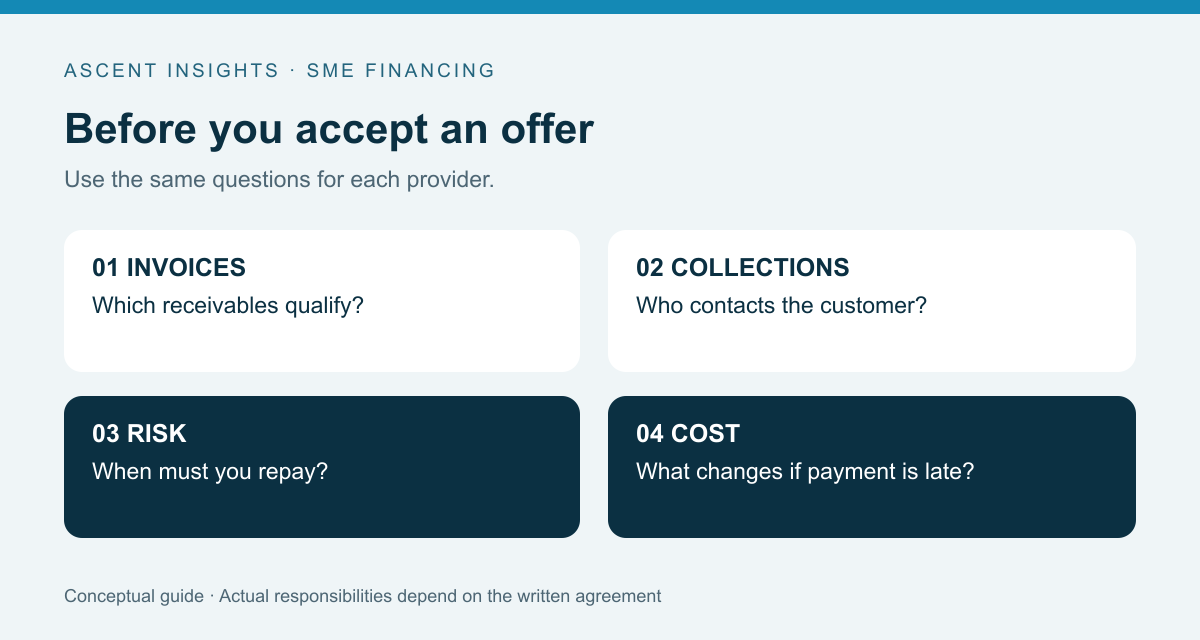
Request a written illustration based on the same invoices and expected payment dates from each provider. Ask each to identify every charge that applies, rather than assuming that similarly named fees cover the same work.
- Funding: What amount can actually be drawn, and what amount is retained until settlement?
- Time: When does the charge start, when does it stop, and what changes if payment is late?
- Services: Which collection, administration or account charges are included or additional?
- Commitment: Are there minimum usage requirements, notice periods or termination charges?
- Exceptions: What happens to costs when an invoice is disputed, withdrawn or repaid early?
These are questions to put to the provider, not a claim that every facility includes every charge. Compare the final cash movement as well as the quoted rate. Keep your own expected customer-payment date realistic, and ask for a second illustration showing a delay. A cheaper-looking offer may be unsuitable if its operating obligations do not match your business.
A decision framework for your SME
Use these situations as discussion prompts, not automatic recommendations or accounts of Ascent clients:
You need funding and collection support
Ask about an arrangement that explicitly includes collections. Review the proposed customer-contact process with whoever owns those relationships in your business. Establish how commercial disputes return to you, and confirm whether the proposed risk allocation matches your expectations.
You need funding but want to keep customer communication
Ask whether a retained-collections arrangement is available for your circumstances. Have the provider explain the payment account, reporting obligations and confidentiality conditions. Check that your finance team can reconcile the arrangement without losing visibility of customer balances.
You do not yet have suitable customer invoices
Do not assume a receivables facility can fund an order that has not reached the invoicing stage. Explain the timing of the purchase, delivery and customer payment. Ascent’s unsecured business-financing overview introduces other facility categories for discussion; availability and suitability still require assessment.
Prepare for a useful financing discussion
Before approaching an adviser or provider, organise a receivables ageing report, customer payment history, invoices and the supporting delivery or acceptance records you already hold. Note any disputes, credit notes, existing financing arrangements or restrictions you know about. This is a preparation checklist, not a universal application-document requirement.
Write down the cash-flow gap you want to address, what the funds would support and what would happen if a major customer paid later than expected. Separate a timing gap from a continuing loss-making activity: describe both honestly rather than expecting funding to resolve every operating issue.
Keep confidential customer records out of public forms or unsecured email attachments. Ask the intended recipient for its appropriate submission channel and required documents before sharing them. For a simpler introduction to the mechanics, read our invoice-financing explainer.
Frequently asked questions
Is factoring the same as invoice financing?
Factoring is a form of invoice finance, commonly associated with collection support. “Invoice financing” is also used as a product label. Compare the actual collection, notification and repayment clauses rather than treating the names as two universally separate products.
Will customers know that I am using a facility?
Do not infer this from the label alone. Ask whether notice is required, who receives payment and when disclosure can occur. OCBC’s published examples demonstrate different approaches; the terms of your own offer remain decisive.
Does non-recourse mean my business has no remaining obligations?
No. Read the exact credit-protection conditions and exclusions, together with your delivery, documentation and reporting obligations. DBS’s explanation is conditional on goods or services being delivered in good order; it is not an unconditional promise covering every unpaid invoice.
Which option is cheaper?
There is no reliable answer from the name alone. Compare written offers using the same invoices, anticipated payment timing, included services and exit assumptions. Ask how the total changes if payment is delayed.
Discuss the structure before applying
The best next step is a clearly defined comparison, not a decision based on a product label. Bring your cash-flow timeline and the questions above to an adviser, then check the proposed terms against the way your business actually operates.
Ascent Consultancy provides Singapore SME financing advisory; it is not the lender. Book a free initial consultation with Ascent to discuss your requirements and possible next steps. Any financing remains subject to the relevant provider’s assessment and terms; a consultation is not an approval or funding commitment.