
Revenue growth alone is not readiness. These are the operational signals we look for before recommending a scale-up plan — and the ones we wait for when they are missing.
Demand you are turning away
The strongest signal is unmet demand: enquiries declined, delivery slots pushed out, customers waiting. Scaling to chase demand you hope will appear is speculation; scaling to serve demand you are already refusing is arithmetic.
Repeatable delivery
If every job still depends on the founder being in the room, growth will multiply your workload instead of your output. Readiness looks like documented processes and a team that delivers to standard when you are not there.
Scale amplifies whatever is already true of the business — including the problems.
Unit economics that hold
Know your margin per job, per product or per customer — and check it holds when volume rises. If bigger months are not more profitable months, fix the economics before you fund more volume.
Cash visibility
Growth consumes cash before it returns it: stock, hires and receivables all move first. Readiness means a rolling cash forecast and funding lined up ahead of need — not arranged in a hurry after the squeeze arrives.
A team with capacity to absorb it
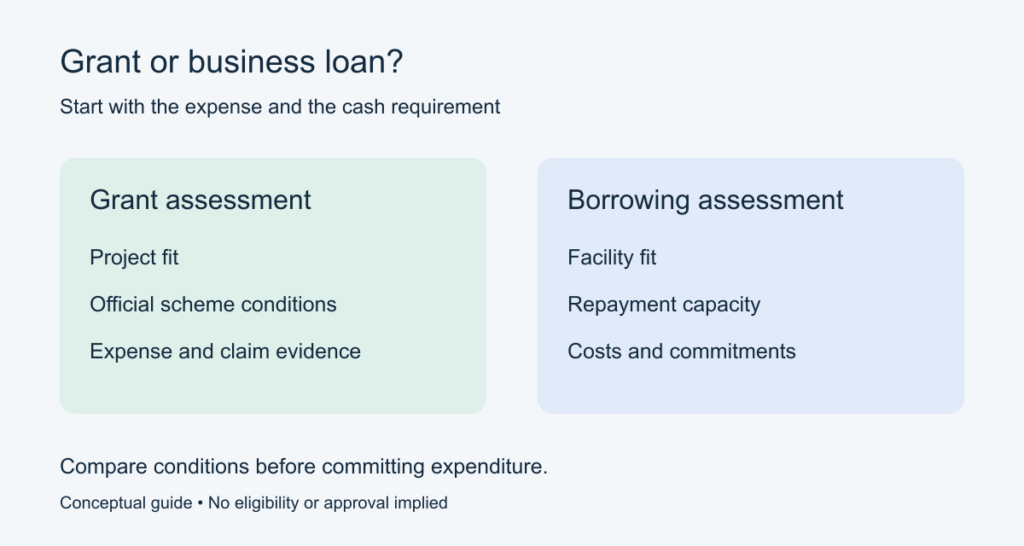
Someone has to run the growth. If your key people are already at their limit, the plan needs hires, systems or both — and schemes like PSG, EDG and WSG hiring support can defray a meaningful share of that cost.
A checklist before you commit
- Demand: evidence, not optimism.
- Delivery: processes that run without the founder.
- Margins: unit economics that survive volume.
- Cash: a forecast and funding arranged in advance.
- People: capacity — existing or planned — to carry the load.
Thinking about your next stage?
We’ll review your numbers and tell you honestly whether now is the time.
Frequently asked
A useful plan is usually weeks, not months: demand evidence, delivery model, unit economics, cash forecast and funding strategy. The discipline is keeping it short enough to act on.
For most Singapore SMEs with proven economics, debt and grants are cheaper than giving up ownership. Equity makes sense when the plan is genuinely unproven or the amounts exceed sensible leverage.
Often, yes. EDG can support capability building and market expansion projects, PSG defrays systems costs, and WSG schemes support the hiring that growth requires.