
A grant and a business loan answer different questions. A grant assessment starts with whether a defined project and its expenses fit the current scheme rules. A loan assessment starts with whether the business can service a borrowing commitment. For a Singapore SME, including a new business, the useful comparison is therefore not simply which route offers funding. It is which route fits the planned expense, the cash needed before support arrives and the obligations the business can carry.
Separate expense reimbursement from repayable borrowing at the outset. Where a scheme reimburses approved expenses, the business must understand what it needs to pay first and what evidence supports a claim. Borrowing creates repayment obligations under the facility agreement. Neither route should be selected on an assumed approval or an expected funding date.
This guide provides a general decision framework, not financial advice. Ascent Consultancy acts as an adviser, not a lender or grant authority. Current official scheme terms and the actual financing agreement must determine any decision.
Define the expense before comparing funding routes
Start with a short description of what the money will pay for. “Business growth” is too broad to test. Separate a proposed software purchase, equipment purchase, capability project or hiring plan from recurring operating expenses and a gap caused by unpaid customer invoices. Each creates a different question about purpose, timing and repayment.
Ascent’s grant advisory service describes support with eligibility, project scoping, applications, submissions and follow-through. Programme names and application routes can change. Enterprise Singapore’s current notice states that EDG, MRA and PSG ceased on 29 September 2026, with new business-grant applications directed to EDGE from 30 September; ongoing applications and projects continue to be processed. See the official Enterprise Singapore transition notice, checked on 19 October 2026. These descriptions identify areas to investigate. They do not establish that a particular business, supplier, purchase or project qualifies today.
Write down the intended outcome as well as the purchase. What business problem should the project solve? Which expense is essential, and which could be deferred? This makes an advisory discussion more useful than asking for the largest possible amount without a defined use.
Compare obligations, not just access to money
| Decision point | Grant route | Business loan route |
|---|---|---|
| Purpose | Does the specific project and expense fit the current official scheme? | Does the facility permit the intended use and fit the business need? |
| Cash before funding | If reimbursement applies, what must the business fund before a valid claim is paid? | What cash is needed before drawdown, and what conditions must be met? |
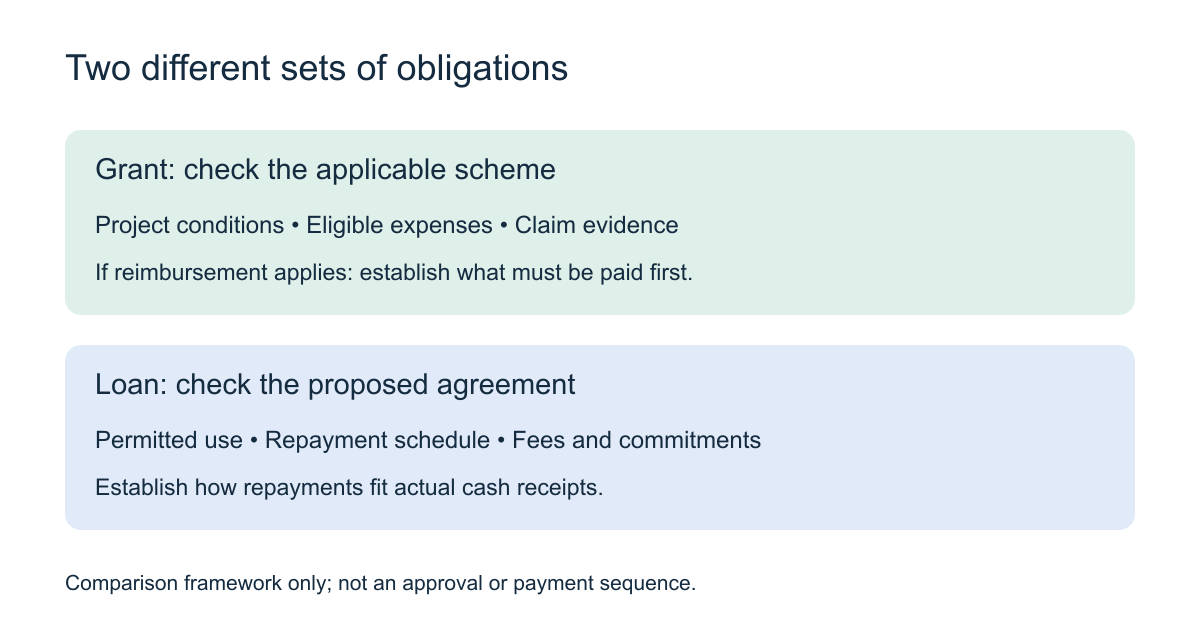
| Ongoing obligation | What project, documentation and claim conditions must be satisfied? | What repayment schedule, fees and other commitments apply? |
| Assessment | Which current eligibility and project requirements need confirmation? | What evidence supports cash flow, credit assessment and repayment capacity? |
| Uncertainty | Can the project proceed if support is unavailable or differs from expectations? | Can the business service the facility if customer receipts weaken or arrive later? |
| Decision authority | The relevant scheme authority determines the application outcome. | The financing provider determines its credit decision and facility terms. |
Use this table to identify missing answers, rather than to declare a winner. An attractive project can still create an unaffordable cash gap. Equally, a facility can be available without being suitable for the expense or repayment cycle.
For reimbursement, test the cash gap explicitly
Do not treat a possible grant as money already available to spend. First establish the applicable scheme’s funding mechanism from current official terms. If support is reimbursed, ask which costs the business must meet itself, what records are required and what conditions must be satisfied before a claim can be accepted. Do not assume every grant follows the same process.
Build a simple project cash schedule using the actual proposed purchase terms. List when each supplier payment would fall due, the cash available for it and which funding assumptions remain unconfirmed. Keep any expected reimbursement separate from confirmed cash. This exposes a funding gap before the business commits to an expense.
Ask whether signing, ordering, paying or starting work could affect the application under the relevant scheme. Rules differ by programme; verify the current official conditions for the application being considered. Obtain the official answer before making an irreversible commitment, rather than relying on a general description of grant support.
If borrowing is being considered to cover that gap, assess it independently. Can the business meet repayments if the expected support does not arrive as planned? An anticipated claim should not substitute for a credible repayment plan.
For a loan, identify the repayment source
A loan comparison needs more than a requested amount. Identify which cash receipts would service the facility and what existing commitments already draw on them. Ask whether the expense protects current cash generation, supports an uncertain future opportunity or simply postpones an unresolved operating shortfall.
Ascent’s unsecured business financing guidance recommends comparing purpose, repayment period, effective cost, personal-guarantee requirements and likely cash-flow impact. It also identifies trading history, financial performance, bank conduct, existing commitments and credit profile as assessment considerations. Prepare the available evidence around those points; do not assume a request is acceptable because its purpose sounds reasonable.
Request the full repayment schedule and a clear explanation of all fees and commitments. Ask what happens if payment is late or the facility needs restructuring. Then compare repayments with the timing of cash entering the business, rather than with sales expectations alone.
Government-assisted borrowing also needs a separate check. Ascent’s guidance explains that government risk-sharing does not remove the participating financial institution’s assessment. Do not confuse a government-assisted loan with a grant, or treat scheme eligibility as a financing approval.
Unsecured and secured financing introduce different checks
Unsecured does not mean commitment-free. Ascent’s guidance states that no business asset is pledged as security, although guarantees may still be requested. A business owner should establish exactly who would be committed under the proposed agreement and what those commitments mean before proceeding.
Where an asset or receivable supports the requirement, Ascent’s secured financing service covers invoices, property, vehicles and equipment. That creates another route to examine, rather than an automatic recommendation. Ask which asset would support the facility, how it would be assessed and what happens to it if obligations are not met.
Keep invoice-related arrangements distinct from a conventional term loan. If the underlying problem is waiting for customer payment, explain that specific collection gap during the assessment. Obtain the actual facility structure and obligations instead of assuming every product called financing works in the same way.
What changes for a new business?
A new business should not begin with the assumption that it qualifies for either route. Eligibility and trading-history requirements differ between programmes and financing providers. Current official grant criteria and the proposed provider’s assessment remain necessary.
For the grant discussion, describe the business’s present activities, the project and the proposed expense without presenting planned outcomes as achieved results. Ask which current requirements apply to a business at this stage and what documents would demonstrate them. Avoid committing expenditure merely because a scheme description appears relevant.
For the financing discussion, separate actual trading evidence from forecasts. Identify what is available, what is missing and which repayment assumptions depend on future sales. A plan that requires immediate success deserves closer examination before the business accepts a fixed obligation.
The practical question is: can this business fund the proposed activity and meet its commitments under a less favourable outcome? If the answer depends entirely on an unapproved grant or uncertain customer receipts, revisit the project scope and funding assumptions first.
Bring a decision pack to the advisory discussion
Ascent’s financing guidance describes a process of clarifying the requirement, reviewing the business profile, comparing suitable routes and supporting the application. Its grant page adds eligibility and project scoping. Use those complementary services to test one coherent funding plan, rather than preparing disconnected applications.
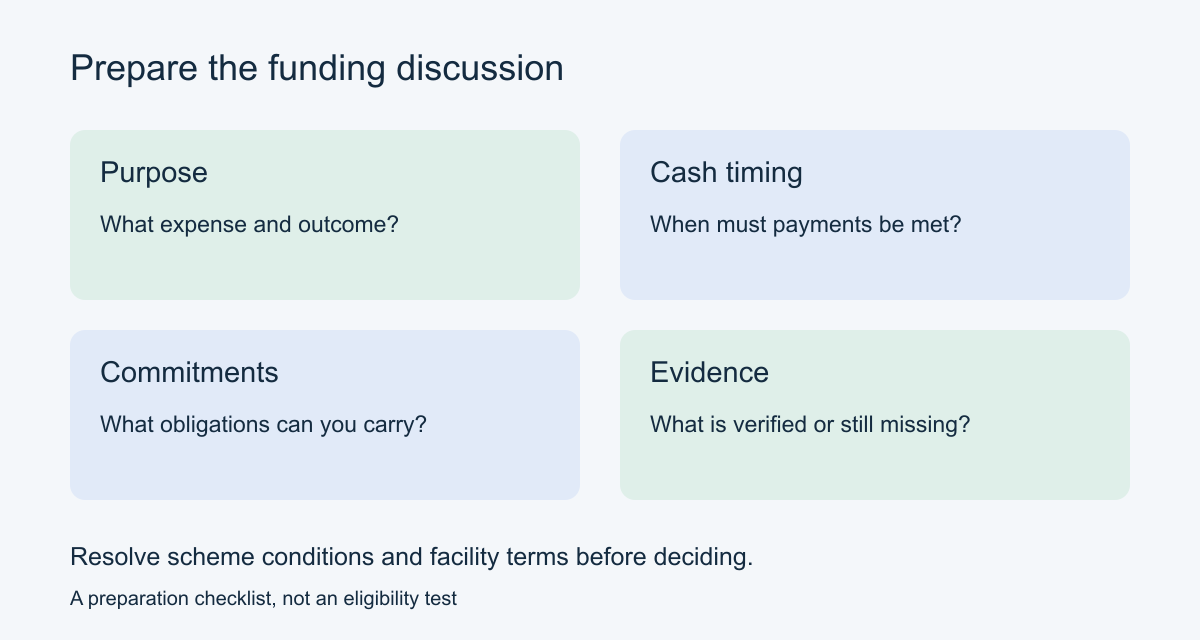
- Purpose: Describe the expense, intended outcome and whether it can be staged or deferred.
- Cash timing: Set out supplier payment obligations, expected customer receipts and available cash.
- Current commitments: Identify existing repayments and other obligations that limit headroom.
- Supporting evidence: Bring available financial information, relevant project documents and any asset or invoice details.
- Unresolved conditions: Record the official scheme questions and facility terms still requiring confirmation.
Ask the adviser to explain why each route fits the need and what would make it unsuitable. For a grant, request confirmation against current official conditions. For borrowing, request an explanation grounded in the proposed agreement and realistic repayment capacity. Neither discussion should end with an assurance of approval.
Choose the route the business can sustain
A grant may be worth investigating when the defined project appears to match a current scheme and the business can meet the applicable funding and claim conditions. Borrowing may be worth assessing when the purpose fits a facility and there is a supportable repayment source. Neither conclusion can be reached from a headline alone.
Before proceeding, resolve the expense, cash gap, conditions and downside obligations in writing. Ascent can help organise the comparison and application preparation. The final decision should rest on verified official scheme terms, the actual financing documents and the business’s capacity to carry the commitment.